What the Guy Behind the Counter Actually Recommended: The B-Movie Underground of VHS Rental Culture
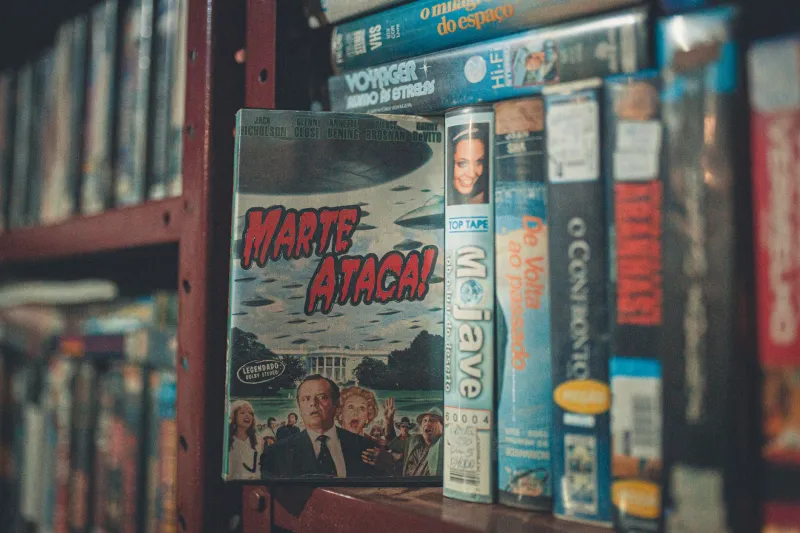
There's a specific kind of movie knowledge that no streaming service can replicate. It lived in fluorescent-lit aisles, on hand-labeled index cards taped to plastic clamshell cases, written in ballpoint pen by someone who'd watched every single title on that wall and had opinions. The video store clerk was America's first algorithm — messier, more personal, and infinitely more interesting.
Before Letterboxd scores and "Because You Watched" carousels, the Staff Picks shelf was the closest thing genre cinema had to a critical apparatus. And what it surfaced was weird. Gloriously, deliberately weird.
The Shelf Nobody Photographed
Most people who grew up renting movies in the late '80s and '90s remember the big titles. The new releases. The wall of horror boxes designed to give you nightmares before you even checked out. But tucked somewhere between the drama section and the wall of westerns nobody touched, there was usually a smaller display — a few dozen titles, hand-curated by whoever happened to be passionate enough to put them there.
These weren't Blockbuster picks. Blockbuster had a corporate inventory system and a famously restrictive acquisitions policy that kept genuinely strange titles off the shelf. The real magic happened at the independents: the family-owned shops, the regional chains with names like Video Vault or Starlight Video or whatever your town called the place that smelled like carpet cleaner and microwave popcorn.
Collector and archivist Derek Soles, who runs a private database of out-of-print VHS titles from his home in Columbus, Ohio, has spent years cataloging what those stores actually stocked. "The majors bought what the studios pushed," he says. "The independents bought what the distributors offered them at a discount, and a lot of that was direct-to-video stuff that had no marketing budget and no theatrical run. It just existed. And the clerks who loved movies — those were the people who found the gems in that pile."
Direct-to-Video Was Never a Death Sentence
The stigma around direct-to-video releases is a modern invention, or at least a retroactive one. In the early '90s, going straight to tape wasn't necessarily a sign of failure — it was often a business decision, a distribution strategy, or the result of a film that simply didn't fit any theatrical category cleanly enough to sell to a multiplex.
Films like The Forgotten (not the 2004 Julianne Moore vehicle — a different, weirder one), low-budget science fiction shot on 16mm that somehow looked more alien than anything playing in theaters, or the entire output of certain regional production companies in Texas and Florida that made action films with local casts and zero name recognition. These titles didn't fail. They just existed in a different ecosystem.
The clerks who loved them became their only publicists. A handwritten note reading "If you liked Terminator, try this — it's stranger and the ending will mess you up" was the only marketing some of these films ever received. And it worked. Not at scale, obviously. But it worked enough to build micro-fandoms that, in some cases, have outlasted the films' original distributors.
The Secondary Market and the People Chasing It
If you want to find these films today, you're largely on your own. Most of them never made the jump to DVD. A smaller fraction have appeared on streaming services — usually through aggregators that license obscure content in bulk — but without any context, any artwork, any of the tactile weirdness that made them feel like discoveries in the first place.
The secondary VHS market has gotten genuinely expensive for certain titles. Collectors on eBay and specialized Facebook groups routinely pay $40, $80, sometimes over $100 for tapes that originally rented for $2.99 a night. The demand isn't just nostalgia. It's preservation anxiety. These are people who understand that if the only copy of a film exists on a degrading magnetic tape in someone's garage in Tulsa, the clock is ticking.
Soles estimates he's tracked down physical copies of over 3,000 titles that have no digital presence whatsoever. "Some of them are genuinely bad," he admits. "Like, unwatchably bad. But some of them are legitimately interesting films that just never had anyone in their corner at the right moment. The clerk who recommended them — that person was their corner."
What Pre-Algorithm Curation Actually Felt Like
There's a tendency to romanticize the video store era, and it's worth being honest about the limitations. Plenty of clerks had terrible taste. Plenty of Staff Picks shelves were filled with whatever the distributor rep had pushed hardest that week. The system was inconsistent, regional, and entirely dependent on whoever happened to be working the Saturday shift.
But that inconsistency was also its strength. You could drive twenty minutes to a different store and find a completely different canon. The clerk at Video Update in your suburb might be obsessed with Italian genre cinema. The one at the place near the university might have organized the entire horror section by director rather than alphabetically, which meant you accidentally learned auteur theory while looking for something with a cool box.
Streaming flattened all of that. The algorithm is the same for everyone, optimized for the same engagement metrics, surfacing the same content to the same demographic clusters. There's no regional variation. There's no handwritten note. There's no person.
What Survived and What Didn't
Some of the films those clerks championed have found second lives. A handful have been rescued by boutique labels — Vinegar Syndrome and AGFA have done notable work pulling obscure direct-to-video titles back into the light, giving them proper restorations and the kind of liner notes that treat them as the cultural artifacts they are. A few have become cult objects with active online communities.
But most of them are just gone. Not destroyed, necessarily — tapes survive — but effectively inaccessible to anyone who doesn't already know they exist. The discovery mechanism that gave them whatever audience they had is gone, and nothing has replaced it.
The video store clerk wasn't a gatekeeper in the pejorative sense. They were more like a local guide — someone who knew the terrain and was willing to point you toward something you'd never find on your own. That function still exists, scattered across Discord servers and niche newsletters and the occasional obsessive blog. But it's never been as efficient, or as accidental, as a handwritten index card on a plastic clamshell in a store that smelled like carpet cleaner.
Somewhere in a storage unit, there are tapes with those cards still attached. That's the archive nobody's cataloging fast enough.